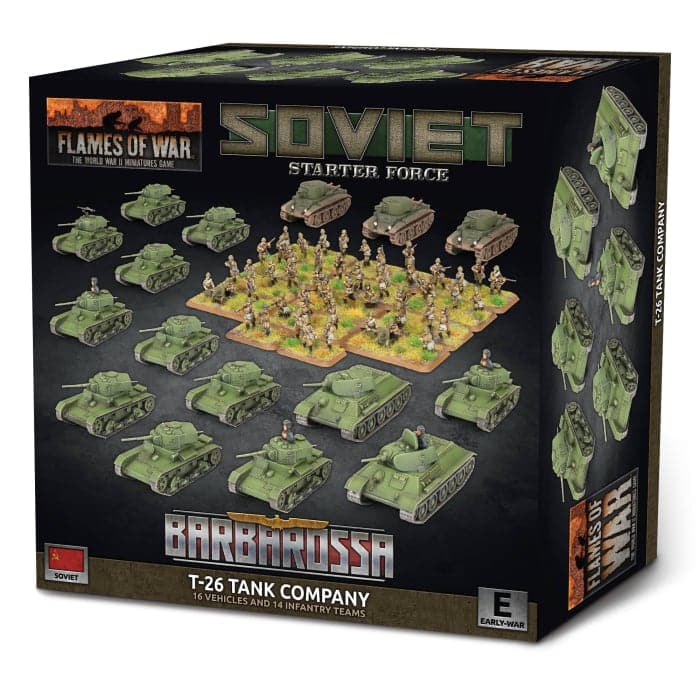
Flames of War Soviet T-26 Tank Battalion Starter Force

Promo !

Redecouvrez la periode Early avec Flames of War Soviet T-26 Tank Battalion Starter Force

The Red Army learned the value of tanks during the Russian Civil War of 1919 to 1921 when they faced them in the hands of the British, French, and White Russian Armies, and then used captured tanks against their former owners. After the war, Soviet industry took a decade to grow to the point where indigenous tank production was a serious prospect. However, once they started along the tank path, they moved much faster than the western powers. This rapid progress had three sources. The first was simply that there was less entrenched power structures to overcome – the Red Army was new and keen on modernisation. The second was the acquisition of foreign designs to kick start their own tank design. The third was the priority that tanks were given in the face of the perceived threat of a counter-revolutionary invasion and the need to spread the Communist revolution to the rest of the world.

With the will and the means to produce as many tanks as needed (at a time when the rest of the world was thinking in terms of a few dozen tanks to try things out), and their pick of the best tank designs in the world, it is not surprising that the Red Army led the world in the field of tanks in the 1930s. It was not only in the area of tank production that they led. The Red Army’s theorists developed a concept of deep operations bearing a lot of similarities to the German Blitzkrieg concept. These theories determined the types of tanks that would be needed.

LIGHT TANKS
The first thing required by the theorists was a breakthrough of the enemy front line. The idea was that massed light tanks would advance with the infantry, destroying enemy machine-gun nests and pinning down the enemy riflemen, allowing the infantry to capture the enemy trenches. This required a relatively cheap and simple design that could be fielded in large numbers. Fortunately, the Vickers-Armstrong company were offering exactly such a design with their 6-ton Type E tank.

T-26 OBR 1932
The Red Army bought some samples from Vickers and then proceeded to produce an unlicensed copy called the T-26. The first production model of 1932 (obr 1932) was a twin turreted
design with two side-by-side machine-gun turrets. While this seemed like a good idea at the time as it appeared to give the tank twice as much firepower, it quickly became
obvious that the difficulties in coordinating two turrets and a driver actually reduced its effectiveness.

T-26 OBR 1933
The second model (obr 1933) was more conventional with just a single turret mounting a 45mm gun and a coaxial machine-gun. The 45mm gun was one of the most powerful tank guns in the world at the time. The original Vickers design mounted a low-velocity 47mm gun (3 pdr). While this was effective against machine-gun nests, its anti-tank performance was woeful, especially compared with the Soviet gun that was used instead.

FLAME-THROWER TANKS
As well as conventional gun-armed tanks, the Soviet Union also created large numbers of flame-thrower tanks, nearly 10% of the entire production run. These KhT-26 and KhT-130 ‘chemical’ (hence ‘Kh’) tanks were fielded in full battalions to add even more punch to assaults on critical positions. As befitted its infantry support role, the T-26 was not much faster than an infantryman and its armour was bulletproof, but not much else. While not exactly desirable attributes, they did make it cheaper and easier to produce allowing the Soviet Union to manufacture over 10,000 of them — more than the total of all other armies’ tank production up to that point.

—

THIS PRODUCT CONTAINS:

  • 11x T-26 Tanks
  • 3x BT-7A Tanks
  • 2x T-34 Tanks
  • 1x Unit Leader Team
  • 1x Komissar Team
  • 10x Rifle Teams
  • 2x HMG Teams
  • 1x Complete A5 Rulebook
  • 2x Decal Sheets
  • 6x Unit Cards

Informations complémentaires

Année

Tranche d'âge

12ans et +

Version

Description

Redecouvrez la periode Early avec Flames of War Soviet T-26 Tank Battalion Starter Force

The Red Army learned the value of tanks during the Russian Civil War of 1919 to 1921 when they faced them in the hands of the British, French, and White Russian Armies, and then used captured tanks against their former owners. After the war, Soviet industry took a decade to grow to the point where indigenous tank production was a serious prospect. However, once they started along the tank path, they moved much faster than the western powers. This rapid progress had three sources. The first was simply that there was less entrenched power structures to overcome – the Red Army was new and keen on modernisation. The second was the acquisition of foreign designs to kick start their own tank design. The third was the priority that tanks were given in the face of the perceived threat of a counter-revolutionary invasion and the need to spread the Communist revolution to the rest of the world.

With the will and the means to produce as many tanks as needed (at a time when the rest of the world was thinking in terms of a few dozen tanks to try things out), and their pick of the best tank designs in the world, it is not surprising that the Red Army led the world in the field of tanks in the 1930s. It was not only in the area of tank production that they led. The Red Army’s theorists developed a concept of deep operations bearing a lot of similarities to the German Blitzkrieg concept. These theories determined the types of tanks that would be needed.

LIGHT TANKS
The first thing required by the theorists was a breakthrough of the enemy front line. The idea was that massed light tanks would advance with the infantry, destroying enemy machine-gun nests and pinning down the enemy riflemen, allowing the infantry to capture the enemy trenches. This required a relatively cheap and simple design that could be fielded in large numbers. Fortunately, the Vickers-Armstrong company were offering exactly such a design with their 6-ton Type E tank.

T-26 OBR 1932
The Red Army bought some samples from Vickers and then proceeded to produce an unlicensed copy called the T-26. The first production model of 1932 (obr 1932) was a twin turreted
design with two side-by-side machine-gun turrets. While this seemed like a good idea at the time as it appeared to give the tank twice as much firepower, it quickly became
obvious that the difficulties in coordinating two turrets and a driver actually reduced its effectiveness.

T-26 OBR 1933
The second model (obr 1933) was more conventional with just a single turret mounting a 45mm gun and a coaxial machine-gun. The 45mm gun was one of the most powerful tank guns in the world at the time. The original Vickers design mounted a low-velocity 47mm gun (3 pdr). While this was effective against machine-gun nests, its anti-tank performance was woeful, especially compared with the Soviet gun that was used instead.

FLAME-THROWER TANKS
As well as conventional gun-armed tanks, the Soviet Union also created large numbers of flame-thrower tanks, nearly 10% of the entire production run. These KhT-26 and KhT-130 ‘chemical’ (hence ‘Kh’) tanks were fielded in full battalions to add even more punch to assaults on critical positions. As befitted its infantry support role, the T-26 was not much faster than an infantryman and its armour was bulletproof, but not much else. While not exactly desirable attributes, they did make it cheaper and easier to produce allowing the Soviet Union to manufacture over 10,000 of them — more than the total of all other armies’ tank production up to that point.

—

THIS PRODUCT CONTAINS:

  • 11x T-26 Tanks
  • 3x BT-7A Tanks
  • 2x T-34 Tanks
  • 1x Unit Leader Team
  • 1x Komissar Team
  • 10x Rifle Teams
  • 2x HMG Teams
  • 1x Complete A5 Rulebook
  • 2x Decal Sheets
  • 6x Unit Cards

Informations complémentaires

Année

Tranche d'âge

12ans et +

Version

Avis

Il n’y a pas encore d’avis.

Soyez le premier à laisser votre avis sur “Flames of War Soviet T-26 Tank Battalion Starter Force”

Maxi Rêves vous recommande

Flames of War Soviet T-26 Tank Battalion Starter Force

Prix public conseillé : 132,00€Votre prix Maxi Rêves : 105,60€ TTC TTC

Disponible le 13 novembre 2026
Cet article vous rapporte 106 Maxi-coins (valeur de 0,88€ )
_x35_9@2x

Paiement
sécurisé

Groupe 212@2x

Livraison
sous 48h

boite-de-livraison@2x

Frais de livraison réduit
dès 120€ d'achats